
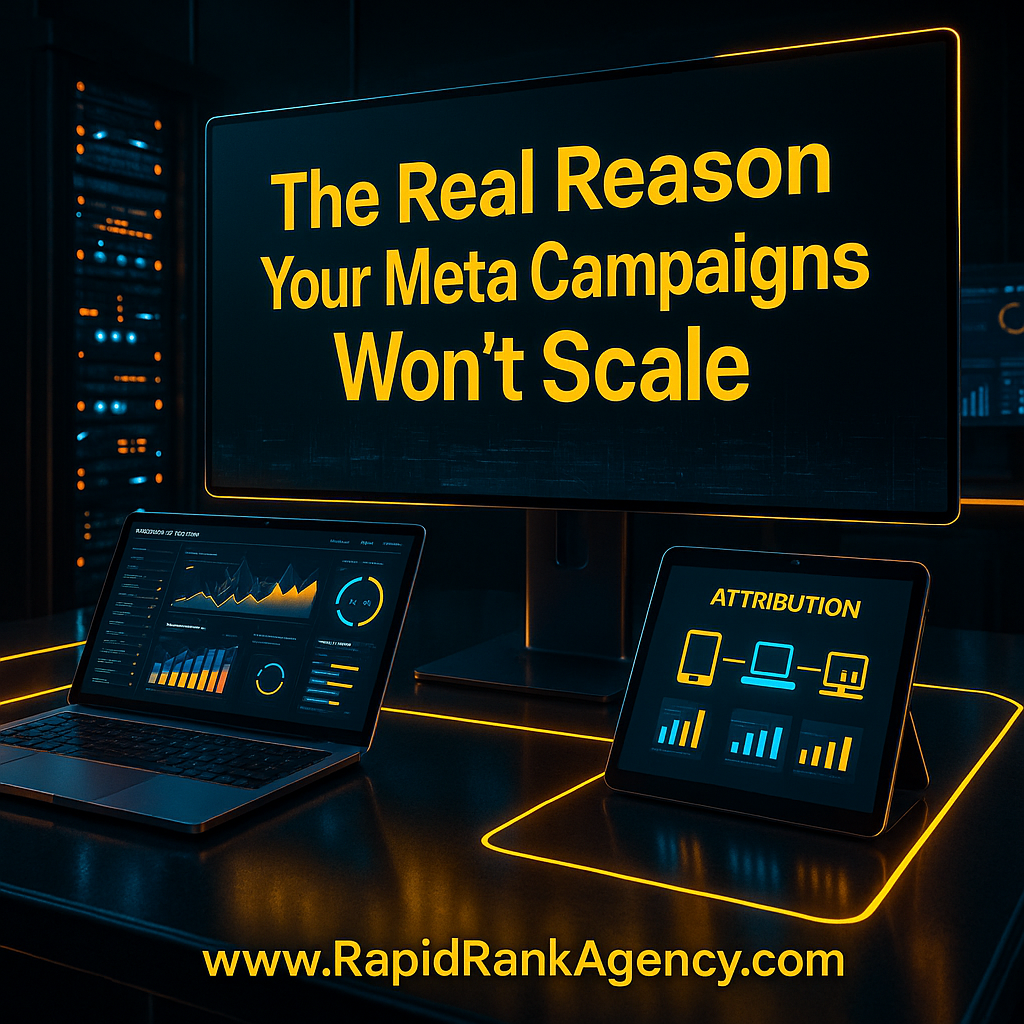
The Real Reason Your Meta Campaigns Won’t Scale
**Understanding Attribution Errors and Their Impact on Ad Campaigns**
In the digital age, where data-driven decisions rule the marketing landscape, misunderstanding user behavior across devices can lead to misguided advertising strategies. This issue arises predominantly due to attribution errors concocted by platforms like Meta, which misidentify user actions when they transition between devices. Correcting these misalignments isn’t just an exercise in technical dexterity; it is vital for accurately attributing conversions and optimizing ad campaign performance.
**Why Attribution Errors Occur**
Attribution errors in Meta’s systems reveal an underlying challenge in digital marketing: the difficulty of accurately tracking user interactions across multiple devices. These errors stem from failures in a process known as “fingerprinting,” which aims to identify a single user despite their device changes.
Consider this scenario: A user, let’s call them User A, interacts with an advertisement on their smartphone, visits the website, and adds an item to their cart. Later, they switch to their iPad, revisit the cart, and finalize the purchase. Herein lies the problem: Meta’s current fingerprinting technology may perceive these sequential actions as being executed by two different users because the switch from a smartphone to an iPad fragments the path.
Such fragmented journeys create multiple false user profiles—Meta assumes User A’s actions across two devices originate from two distinct individuals. This separation leads to erroneous attribution, affecting how conversions are understood and how advertising efforts are evaluated and adjusted.
**Unraveling the Misunderstandings**
The solution to these inaccuracies begins with tracing these dual interactions back to a single origin. The technique involves rectifying the attribution by aligning these fragmented user paths into a cohesive, singular narrative. Here’s how it works:
– **Initiating Checkpoints:** Each user interaction on a platform like Meta begins with a unique identifier, such as a “Facebook click ID.” For every ad interaction, this ID tags the user’s activity trail.
– **Reconciliation of Click IDs:** When a device switch occurs, the subsequent actions attract a new Facebook click ID. Meta’s current system may presume a new user from this new ID, severing the journey. Marketing experts recommend reconciling these IDs – replacing the mistaken second click ID with the original to demonstrate continuity in the user journey.
– **Educating Meta:** By informing Meta about this correction, it helps reassign the actions back to the originating campaign instead of dispersing them. Reassuring Meta about the shared origins enables campaigns to scale and recognize genuine conversion pathways.
**The Learning Moment: What Marketers Need to Know**
This understanding transforms the approach marketers take towards tracking user interactions. Insight into attribution errors widens the scope for improvement in campaign performance:
– **Integration Over Isolation:** By connecting all touchpoints across devices to a single identifier, marketers reduce data fragmentation and improve the accuracy of user behavior analytics.
– **Data Consistency:** By ensuring that Meta reads continuous user journeys correctly, marketers pursue more informed and effective advertising strategies, leading to enhanced conversion rates and ROI.
– **Proactive Approach:** Equipped with knowledge about the inner workings of attribution, marketers can proactively anticipate and correct data misalignments, ensuring that campaign analysis is based on facts rather than fallacies.
**Closing Reflections**
Consider the reverberating implications. If a single misalignment in attribution can set an entire campaign off course, how can this revelation reshape your marketing blueprint today? Which strategies will you refine to make sure your data-driven decisions genuinely reflect user behavior? As technology and consumer habits evolve, adapting to these shifts requires vigilance, understanding, and a willingness to delve into the nuances of attribution. Only then can one truly harness the potential of digital advertising and drive impactful business outcomes.